 Computer Programming
 Web Programming
 Computer Science
 Computer Network
 Computer Database
 Computer Architecture
 Computer Security
 Operating Systems
 Office Applications
 Computer Graphics
 Other IT Topics
Web Programming Tutorials: Free PDF Guides & Resources
Web Programming (HTML/CSS, PHP, JS...) — every PDF on this page is free to download, with no account required.
Filters & sort 113 PDFs
TypeScript Deep Dive: Compiler Error Reporting
Discover how to handle TypeScript compiler errors and improve your coding with our comprehensive guide on error reporting and common issues.
Open
PHP Hot Pages: Master Dynamic Web Development Skills
Download free PHP Hot Pages PDF. Learn dynamic content creation, form handling, database integration, and best practices. Perfect for beginner developers.
Open
JavaScript for Beginners: Forms & User Input
Learn JavaScript forms with this free PDF. Covers validation, user feedback, error handling, and form submission. Perfect for web developers.
Open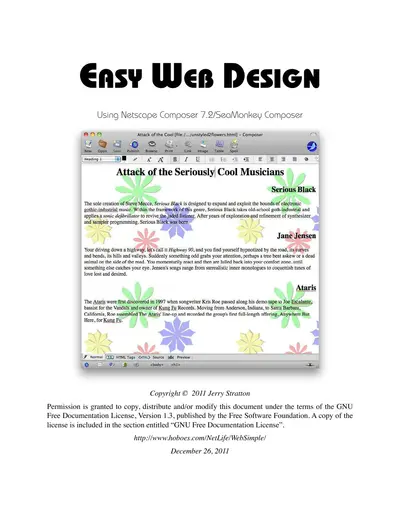
Easy Web Design: Beginner's Guide to Web Creation
Download free Easy Web Design PDF. Learn HTML basics, image insertion, linking techniques, and table creation. Perfect for aspiring web designers.
Open
CSS Cascading Style Sheets: Practical Styling Guide
Discover essential CSS styling techniques and guidelines for modifying documents effectively. Enhance your web design skills today!
Open
Django: Beyond the SQL — Blog Development Guide
Discover how to create a dynamic blog with Django, focusing on templates, URL structures, and customization techniques for better user engagement.
Open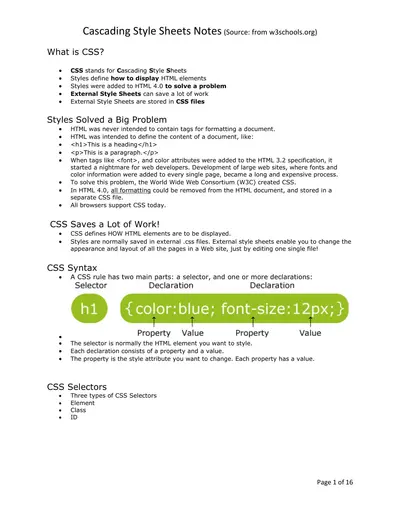
Cascading Style Sheets Notes: CSS Basics & Navigation
Master core CSS concepts and practical techniques for styling, positioning, and creating responsive navigation bars. Includes examples and hands-on exercises.
Open
Dreamweaver CS6 Styling and Layout Using CSS
Practical Dreamweaver CS6 guide that teaches CSS basics, Inspect Mode debugging, box-model control, modular selectors, Live View workflows, responsive layouts.
Open
Adobe Dreamweaver Essentials for Web Design Beginners
Hands-on Dreamweaver guide for building responsive web pages: core HTML structure, CSS styling, navigation, Live/Split View workflows, and accessibility basics.
Open
JavaScript Basics: A Comprehensive Guide for Beginners
Discover essential JavaScript concepts, syntax, and functions in this beginner-friendly guide. Start coding with confidence today!
Open
Mastering jQuery Fundamentals: A Complete Guide
Explore the comprehensive jQuery Fundamentals PDF to build strong web development skills with practical examples, modular code, and best practices.
Open
Professional Node.JS Development
Explore comprehensive Node.js development techniques, ES6 features, performance optimizations, and testing strategies in this professional guide.
Open
Carnival of HTML: Essential HTML Fundamentals
Discover the fundamentals of HTML, including structure, tags, and SEO best practices. Perfect for aspiring web developers and designers.
Open
Mastering JavaScript Promises: Async Programming Simplified
Learn JavaScript promises with this comprehensive guide covering async handling, chaining, error handling, and practical use cases.
Open
Building Web Apps with Go: Beginner to Advanced Guide
Learn to build powerful, secure web apps with Go using templates, routing, testing, and database integration. Step-by-step guidance for developers.
Open
Sass in the Real World: book 2 of 4
Explore advanced Sass control directives, custom functions, and grid systems to elevate your CSS development skills with this comprehensive guide.
Open
Sass in the Real World: book 1 of 4
Learn how to use Sass for scalable CSS with expert file structures, variables, mixins, and modular design from Sass in the Real World.
Open
Mastering WordPress: The Right Way
Practical guide to WordPress development: WP-CLI, safe migrations, testing, deployments, i18n and JS best practices to build secure, maintainable sites.
Open
Front-End Developer Handbook: Complete Guide for Beginners
Download free Front-End Developer Handbook PDF. Learn HTML basics, CSS techniques, JavaScript tools, and responsive design. Perfect for aspiring developers.
Open
Web Programming in Python with Django
Download free Web Programming in Python with Django PDF. Learn models, views, URL structure, and templates. Perfect for beginner developers.
OpenAbout Web Programming PDFs
Web Programming covers technologies and languages for building websites and web applications, including HTML, CSS, JavaScript, and server-side technologies like PHP, Node.js, and frameworks.
Web programming is the process of creating and maintaining websites, web applications, and other digital products that are accessed over the internet. It involves the use of programming languages, frameworks, and tools to design and develop these web-based products.
Web programming languages include HTML, CSS, and JavaScript, which are used for creating the structure, style, and interactivity of web pages. Server-side languages like PHP, Python, and Ruby on Rails are used for processing user inputs and generating dynamic content. Databases such as MySQL and PostgreSQL are used for storing and retrieving data.
Web programming also involves the use of various web development frameworks and tools that simplify and automate the development process. Examples of popular web development frameworks include Angular, React, and Vue for front-end development, and Laravel, Django, and Ruby on Rails for back-end development.
As the internet continues to grow and evolve, web programming has become an increasingly important skill for businesses and individuals alike. Websites and web applications have become essential tools for communication, commerce, and entertainment, and the demand for skilled web developers is on the rise.
Web programming is an exciting and dynamic field that requires a combination of technical skills, creativity, and problem-solving abilities. It offers a wide range of opportunities for individuals who are interested in pursuing a career in technology or who simply want to create their own web-based projects.
The Features of Web Programming
Web programming has several features that make it an essential tool for creating and maintaining web-based products. Here are some of the key features of web programming:
- Accessibility: Web-based products can be accessed from anywhere in the world, making them accessible to a wide range of users. This makes web programming a powerful tool for communication, commerce, and entertainment.
- Interactivity: Web programming allows for the creation of interactive web-based products, such as web applications, that can respond to user input and provide a personalized user experience.
- Scalability: Web programming allows for the creation of web-based products that can scale easily to accommodate a growing number of users and data.
- Security: Web programming includes several security measures, such as encryption and secure socket layers (SSL), that can protect sensitive data and prevent unauthorized access.
- Cross-platform compatibility: Web-based products can be accessed from any device with a web browser, making them compatible with a wide range of platforms.
- Rapid development: Web programming frameworks and tools can help to streamline the development process, allowing web developers to create web-based products quickly and efficiently.
- Cost-effective: Web-based products can be developed at a lower cost compared to traditional software applications, making them a cost-effective option for businesses and individuals.
Web programming offers a wide range of features that make it an essential tool for creating and maintaining web-based products. Its accessibility, interactivity, scalability, security, cross-platform compatibility, rapid development, and cost-effectiveness make it an attractive option for businesses and individuals alike.
Skills Requirement
Web programming requires a diverse set of technical and non-technical skills to be successful. Here are some of the key skills that are required for web programming:
- Proficiency in programming languages: Web programming involves the use of various programming languages like HTML, CSS, JavaScript, PHP, Python, and others. A web programmer needs to have a strong understanding of these programming languages to create and maintain web-based products.
- Familiarity with web development frameworks: There are several web development frameworks available, such as React, Angular, Vue, Django, Laravel, and Ruby on Rails. Familiarity with these frameworks can help a web programmer to streamline the development process.
- Understanding of web design principles: A web programmer should have a good understanding of web design principles like user experience, user interface, and accessibility. This knowledge can help to create web products that are easy to use and visually appealing.
- Knowledge of databases: A web programmer should be familiar with databases like MySQL, PostgreSQL, MongoDB, and others. Understanding how to use these databases is important for creating dynamic web applications that can store and retrieve data.
- Problem-solving skills: Web programming involves identifying and solving technical problems. A web programmer should be able to identify and troubleshoot issues effectively and efficiently.
- Attention to detail: A web programmer should have strong attention to detail to ensure that all aspects of a web product are functional, aesthetically pleasing, and meet the client's requirements.
- Communication skills: Web programming often involves working in teams or with clients. Strong communication skills are necessary to convey ideas and work collaboratively.
- Continuous learning: The field of web programming is constantly evolving, and a web programmer needs to stay up-to-date with the latest trends and technologies. A willingness to learn and adapt is essential to stay relevant in this field.
Web Frameworks
Web programming frameworks are pre-built software libraries that provide a structured approach to web application development. They simplify the development process and provide a consistent set of tools and practices that make it easier to create complex web applications. Here are some of the most popular web programming frameworks:
- React: React is a JavaScript library for building user interfaces. It is used for building complex single-page applications that require real-time data updates. React uses a component-based architecture, which makes it easy to build and reuse UI elements.
- Angular: Angular is a popular front-end framework for building dynamic web applications. It is built on TypeScript, a superset of JavaScript, and provides a range of tools for building scalable and robust applications.
- Vue: Vue is a lightweight JavaScript framework for building user interfaces. It is designed to be easy to learn and use, and provides a range of tools for building responsive and dynamic web applications.
- Django: Django is a Python-based web framework for building web applications. It provides a range of tools for building scalable and secure web applications, including a powerful Object-Relational Mapping (ORM) system.
- Laravel: Laravel is a PHP-based web framework for building web applications. It provides a range of tools for building scalable and secure web applications, including a powerful template engine, a robust ORM system, and built-in authentication.
- Ruby on Rails: Ruby on Rails is a popular web framework for building web applications. It is built on the Ruby programming language and provides a range of tools for building scalable and secure web applications, including a powerful ORM system and built-in authentication.
Web programming frameworks can significantly simplify the development process and improve the quality of web applications. By providing a consistent set of tools and practices, web programming frameworks make it easier to build complex web applications and reduce the time and effort required to develop them.
How to Get Started
If you're interested in learning web programming, here are some steps you can take to get started:
- Choose a programming language: The first step in learning web programming is to choose a programming language. Some popular programming languages for web development include HTML, CSS, JavaScript, Python, Ruby, and PHP.
- Learn the basics of web development: Before you start learning a specific programming language, it's important to understand the basics of web development. This includes learning about web servers, HTTP protocols, and how the internet works.
- Learn HTML and CSS: HTML and CSS are the building blocks of web development. HTML is used to create the structure of a web page, while CSS is used to add style and formatting. There are many resources available online for learning HTML and CSS, including tutorials, videos, and online courses.
- Learn a back-end programming language: Once you've mastered HTML and CSS, you can start learning a back-end programming language such as Python, Ruby, or PHP. Back-end programming languages are used to create the logic behind a web application and interact with databases.
- Practice coding: The best way to learn web programming is to practice coding. Start with simple projects and gradually work your way up to more complex ones. You can also participate in online coding communities and forums to get feedback on your code and learn from others.
- Learn a web framework: Web frameworks can significantly simplify the development process by providing a set of tools and best practices. Once you've learned a programming language, you can start learning a web framework such as React, Angular, or Django.
- Keep learning: Web development is a constantly evolving field, so it's important to keep learning and staying up-to-date with new technologies and best practices. Follow blogs and online communities, attend conferences and workshops, and take online courses to continue building your skills.
Learning web programming can take time and practice, but with dedication and persistence, you can become a skilled web developer and create amazing web-based products.